By Bonnie Withers
It was closing time at the National Library of Austria in Vienna and Dick and I were making a dash through the main passage toward the doors. I was unhappy to have to rush past several vitrines full of tantalizing books and manuscripts. But then I came to a stop at a large display case that, unlike the others, held only a single book. The label gave me chills. Here was the book I had read about in Out of the Flames, Christianismi Restitutio, by Michael Servetus, one of only three copies known to have survived his violent death at the stake in 1553. (A second copy is in the Bibliothèque Nationale in Paris and the third is in the University of Edinburgh Library and Collections.)
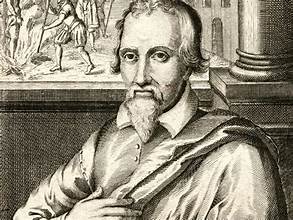
Servetus was born in Spain in 1511. He was incredibly bright, free-thinking, and reckless, publishing his book, On the Errors of the Trinity, when he was only nineteen. This book upset a lot of folks and got him the attention of the Spanish Inquisition. He escaped to France and lived for many years under an assumed name, became a physician and teacher, studying science and law.
After twenty years of living quietly, Servetus started a correspondence with Calvin, annoying him with his views on the Trinity and other Biblical interpretations. When Calvin sent one of his own books to Servetus, it was returned to him all marked up with comments and corrections. Calvin was not amused. Calvin, who was headquartered in Geneva, warned Servetus to stay out of that city. In an arrogant move, Servetus stopped there anyway on his way to Italy and was arrested and charged and convicted of heresy. Calvin argued that his punishment should be beheading, but the town fathers went for a more gruesome death. Servetus was burned alive at the stake with his manuscripts and books bound to his body.
The arguments of Servetus regarding the trinity are complex in a way that makes it a stretch to call him the “father of Unitarianism”. He stated that the whole totality of God resides in the figure of Christ, rejecting the division into three entities. His views certainly did inform the thinking of the Socinians and that’s where the line to the present can be drawn. Moreover, his violent death shocked many and brought attention to a need for more tolerance regarding religious thought. We can certainly honor Servetus as an early champion of free thinking and religious liberty.
Note: Out of the Flames: The Remarkable Story of a Fearless Scholar, a Fatal Heresy, and One of the Rarest Books in the World is by Lawrence and Nancy Goldstone, 2003.